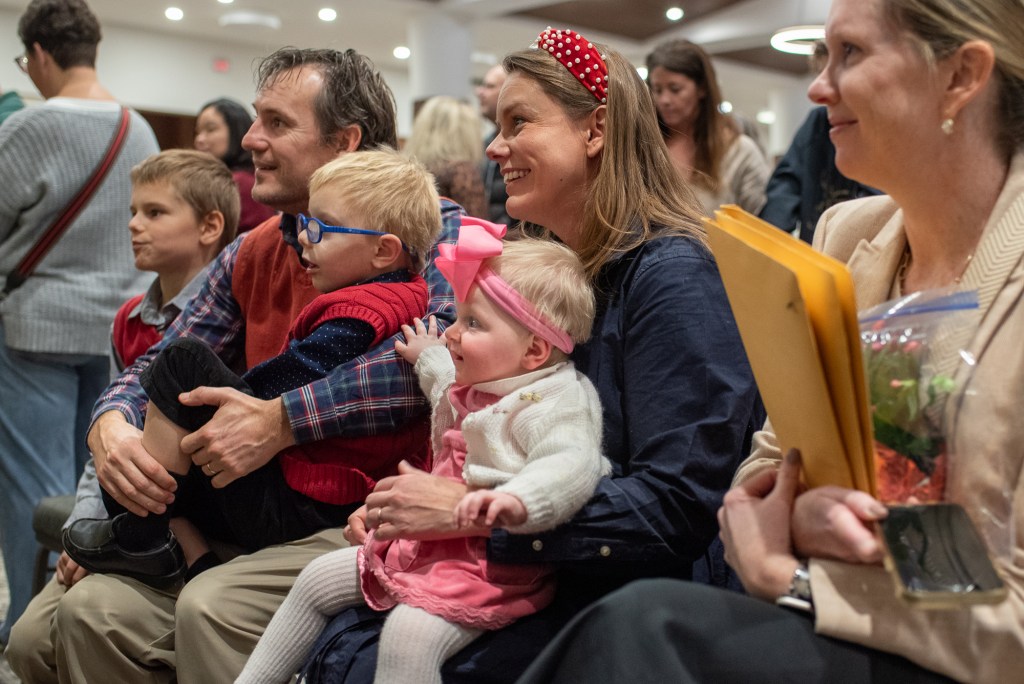
Last Friday, on the steps of City Hall, elected officials and local community leaders read out six stories compiled from interviews with refugees from Syria, Ukraine, Myanmar, Democratic Republic of the Congo, Somalia, and Uganda.
The theme of the day was “courage.” The stories meandered through different pieces of refugee life. Many focused on the courage of leaving behind everything you knew to come to a new country. They spoke about the challenges of readjustment, and the way that the community had helped to support them. A Rohingya girl spoke about learning to drive, which had never felt possible before. A Syrian girl, who had spent years first in Egypt, said that American culture focused too much on work at the expense of life, while Egyptian culture focused on life but it was hard to find good work.
None of the people whose stories were told were there that day. At the end of every story, the speaker read out the same line: “I speak today for the New Americans in our city for whom it would be too dangerous to be here today.”
For 15 years, the centerpiece of World Refugee Day celebrations was a Saturday festival that brought 500 people to Schiller Park, said its organizers. But this year, amid an immigration crackdown by U.S. Immigration and Customs Enforcement across the country, organizers worried for the safety of their community.
So this year, the festival full of food, dance, music and soccer was canceled. The traditional march from the County Courthouse to City Hall, which used to kickstart the celebrations, was expanded to an hour of sharing stories and statistics about the refugee community.
Forty-six flags representing Syracuse’s vibrant refugee and immigrant communities were carried down Syracuse streets and the United Nations flag was raised into the sky. A proclamation signed by the county executive and mayor officially designated June 26 World Refugee Day.
“[World Refugee Day] is one day each year when we celebrate not where we’ve come from, but who we’ve become together. That’s what made the decision to cancel this year’s festival so heartbreaking,” Hassina Adams, the President of the New Americans Forum and one of the organizers of World Refugee Day, said. “But canceling the festival doesn’t cancel our community.”
In recent months, U.S. policies protecting refugees, asylum seekers, and other people with protected statuses have changed dramatically.
Asylum seekers, who apply for status after arriving on United States soil, have been targeted by ICE for detention and deportation. Immigration parole programs for asylum seekers, like CBP One, have been terminated, and status achieved through those programs has disappeared. Many who entered the country legally and took the steps to maintain their status now find themselves suddenly without it.
One day before the march, the Supreme Court allowed the Trump Administration to end temporary protected status for Syrians and Haitians fleeing violence and national disasters. The administration has previously ended status for people from 13 other countries.
The administration has also asked for a thorough review of all refugees who entered during the Biden presidency.
“We didn’t want to put our community at risk and create this kind of corralling of people into one area,” said Adams. “God forbid if something happened, we would have no power to stop any ICE campaigns.”

Fears of the changing immigration systems were present in some of the stories that were read out. One woman wrote that her mother carried her U.S. passport everywhere she went. Two others had written about their constant fear of being taken from their children, unable to get in touch and tell them where they’d gone.
“The hardest part is not knowing what tomorrow will bring. Not knowing if your family will stay together. Not knowing if all the hard work you have put into building a life here will be enough,” said one woman from the Democratic Republic of Congo. “But courage is not about pretending that fear does not exist. It is about refusing to let fear stop you.”
Syracuse has resettled thousands of refugees. For several years, over a quarter of all refugees resettled in New York ended up in Onondaga County. Half of the valedictorians and salutatorians graduating Syracuse City School District this year came from refugee or immigrant families, according to statistics included in the stories read at City Hall.
Adams remembers her first World Refugee Day in Syracuse. It was the summer of 2015 or 2016, she said, shortly after her family arrived in Syracuse in March 2015. There was a festival at Schiller Park. When she got there, she was in awe.
The park was full of kids in cultural garb, eating ice cream, playing music that she recognized. It was full of people she could relate to, she said.
“There was a great sense of community and belonging, of different races and cultures all gathered in one place to celebrate unity,” Adams said. “And I know times were tough. Because folks were navigating, acclimating to a new environment, and whatever other challenges. But the atmosphere was still jovial.”
In the decade since, Adams has become the president of Syracuse’s New Americans Forum. Now, it’s her responsibility to help organize World Refugee Day. But the atmosphere has changed – now, she says, it’s “somber.”
“There was no kind of doom and gloom that we currently experience now,” Adams said. “So the juxtaposition is extremely evident from where we came from to where we are now.”
The changes to World Refugee Day began last year. Even though there was a festival, it was less well-attended than it had been in the past: They handed out tickets to around 350 people as compared to historic averages around 500, Adams estimated. That year’s theme was “community as a superpower.”
As they prepared to raise the UN flag over City Hall, New Americans Forum Vice-Chair Mohamed Thiam spoke about the generations of immigrants that had come to Syracuse and to Onondaga County. He spoke to the courage of refugees today, and to the history of courage on American land in fights against slavery, Jim Crow, and more. He called each generation to “look upon our imperfection” and strive to remake the US to be closer to its highest ideals.
“Let [the flag] remind us that behind every refugee statistic is a human being, a family, a dream, and a story. Let it remind us that the measure of community is not how it treats the powerful, but how it welcomes the vulnerable,” said Thiam. “Most importantly, let it remind us that courage is contagious.”
Read more of Central Current’s coverage

Onondaga County elections guide 2026
Central Current has prepared a paywall-free election guide to help inform you about the candidates and issues shaping each race.

2026 General Election Q&A: Onondaga County Legislature 14th District candidate Jessica Dapson
Democrat Jessica Dapson is running to represent the legislature’s 14th District. She faces Cody Kelly in the race for the seat.

2026 General Election Q&A: Onondaga County Legislature 2nd District candidate Matt Jones
Democrat Matt Jones is running to represent the legislature’s 2nd District. He faces Kevin Meaker in the race for the seat.
2026 General Election Q&A: Onondaga County Legislature 15th District candidate Jo Bennett
Democrat Jo Bennett is running to represent the legislature’s 14th District. They face Woodruff Carroll in the race for the seat.
2026 General Election Q&A: Onondaga County Legislature 17th District candidate Laura Lavine
Republican Laura Lavine is running to represent the legislature’s 17th District. She faces Majority Leader Nodesia Hernandez in the race for the seat.