For over 90 years, an 11-foot statue of Christopher Columbus has loomed 30 feet over downtown Syracuse — but a removal may be soon in store.
After a decade of discussion, Syracuse residents will soon see three visions for a new design of the city’s Columbus Circle.
On Tuesday at St. Paul’s Episcopal Church at 6 p.m., the three finalists of the Full Circle Redesign Competition — a contest overseen by the Onondaga Historical Association with help from the non-profit Forecast Public Art — will present their visions for a refashioned space.
The Columbus monument has for years sparked spirited debate between local residents supportive of the statue and others calling for its removal.
The statue was commissioned and funded by Italian immigrants during the Great Depression, and is an enduring symbol of pride for many in Syracuse’s Italian-American community.
For many other residents — including the outspoken advocacy group We of Italian and Syracuse Heritage — the statue symbolizes extraction, slavery, and the Doctrine of Discovery that European explorers used to justify their conquest of Indigenous people already living in the so-called “New World.”
The redesign competition seeks to bridge the gap between these factions and envision a space surrounding the Columbus monument that continues to recognize the contributions of Syracuse’s Italian immigrants while integrating the legacies of other communities that call Syracuse home.
Although artists were free to choose whether to include the Columbus monument in their redesign proposals, Onondaga Historical Association Executive Director Lisa Romano Moore said she expects that the finalists will likely unveil design proposals that include the removal of the Columbus statue, though that wasn’t a pre-requisite.
The competition’s finalists — Creative Urban Academy, Rafael Lozano-Hemmer, and TEN X TEN And MASARY — each have experience designing profound and interactive cultural spaces, said Moore. Following the presentation at St. Paul’s, the finalists’ redesign proposals will be on display at OHA through Nov. 24.
While the OHA is playing a lead role in the design competition, it did not select the finalists, who were chosen by a curatorial committee.
“How do we contend with monuments that are honoring some, and others feel that it’s a sign of the policies and the practices of a country or a people that contributed to oppression?” Moore said. “So we don’t have a position on whether the monument should remain or go. We have a position on the monument as a historic object in a historic district, no less.”
The space around the Columbus monument is every bit as historic as the statue at its center, Moore argued. Surrounding the statue are institutions to justice, governance, faith and religion, and Syracuse’s civil rights history: Onondaga County Courthouse, the Civic Center, the County Office Building, Cathedral of the Immaculate Conception, the Mizpah event wine bar in the historic First Baptist Church, and the Wesleyan Church, once a stop on the Underground Railroad.
“The history of Syracuse is so deeply told in that space,” Moore said. “… The space also tells the story of the future, right? You’ve got a downtown that’s really kind of clawing its way back to being a place where people live, where people come to experience social and recreational activities and dining.”
Opposing statue’s removal
But the Columbus Monument Corporation, representing Italian-Americans who want to see the statue keep its central position downtown, do not share Moore’s optimism in the redesign competition.
The organization participated in years of dialogues led by Interfaith Works and the City of Syracuse under former Mayor Ben Walsh, but has not engaged with the Full Circle redesign competition despite being invited to provide input and perspective to the competition’s curatorial committee before it selected the finalists.
Anthony Ilacqua, a representative of the corporation, said that the stakeholders in the dialogue sessions overseen by the Walsh administration failed to reach a consensus opinion of what the city should do with the statue.
Ilacqua and other statue supporters see the competition as an underhanded attempt to fulfill what they believe the city and OHA want — removal of the Columbus statue from downtown Syracuse.
“We declined to participate in this full circle design competition, because we believe that the entire process is preordained toward removal of the statue,” Ilacqua said. “So, we want to preserve our right to pursue legal action should it become necessary to preserve the statue and the monument in its present location.”
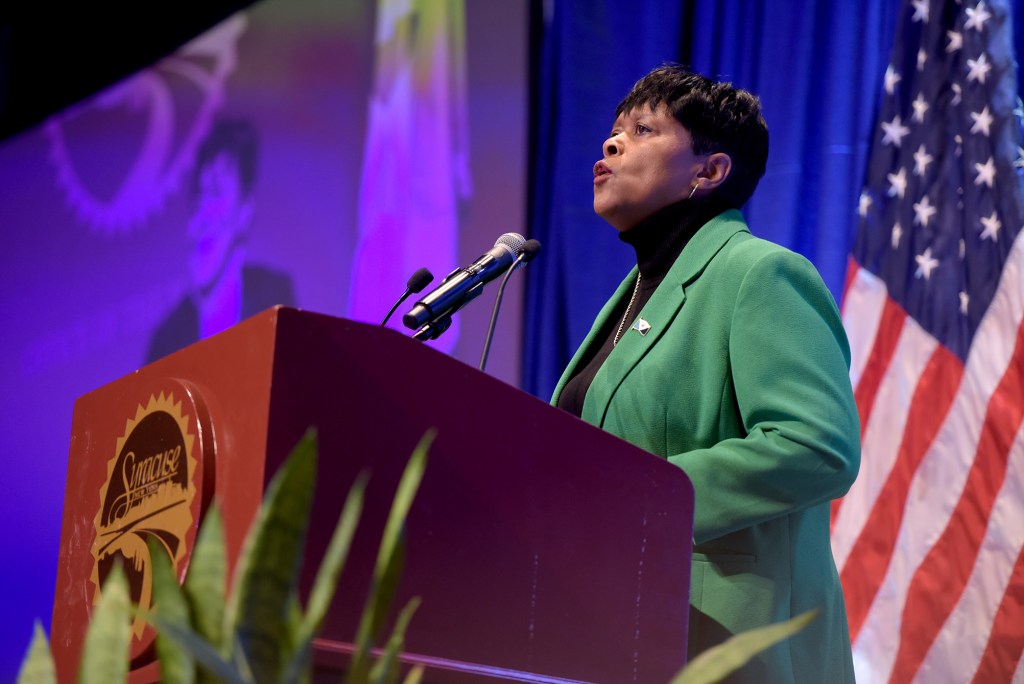
While Walsh and Mayor Sharon Owens have indicated their desire to remove the statue (Owens pledged to do so during Central Current’s Democratic Mayoral Forum), the city itself is not overseeing the competition.
Once the contest designates a finalist, the city will still have to approve funding for any redesign plan, meaning nothing is yet set in stone.
For Ilacqua and many others in Syracuse, ancestral connections are carved into the Columbus statues’ bronze. Ilacqua’s father was 22 years old at the time of the statue’s original dedication in 1934. Almost half a century later, Ilacqua joined his dad in 1992 at the city’s rededication and restoration of the monument, a celebration of the 500th anniversary of Columbus’ famous voyage.
“I remember seeing him, a little tear on his cheek, and I remember seeing what it meant to him because he was there when it was originally dedicated, and he was there with me at 80 years old to see it restored.” Ilacqua said. “It means so much to us. It’s not some little thing. It’s not some inanimate object that’s distanced from our families. It’s something we’re attached to.”
Syracuse’s Columbus statue, like so many others around the nation, was a response from Italian immigrants to the repression and anti-immigrant sentiment that was common in the late nineteenth and early twentieth centuries — including the infamous 1891 lynching of 11 Italian immigrants in New Orleans.
To Italian immigrants at the time, Columbus and his voyage across the Atlantic into what was, for him, the unknown symbolized undaunted courage and mirrored the trajectory that had brought these Italian immigrants to the United States.

Onondaga Nation cites harm by Columbus
In recent years, though, Columbus has come to symbolize something far different to other communities in Syracuse, including the Onondaga Nation.
“Historians are very clear what happened in the Caribbean, and as a result of what started there. It was the beginning of the Atlantic slave trade,” said Joe Heath, lead counsel for the Onondaga Nation. “He took at least six Indigenous people in chains back to the queen and presented them as gifts, essentially, so that they could be Christianized.”
The Onondaga participated in the Interfaith Works dialogue sessions with the Columbus Monument Corporation, but have concluded from that experience that the corporation is not committed to compromising on the statue, regardless of any stated overtures to compromise.
Beyond the legacy of Columbus himself, the Onondagas object in particular to imagery beneath the statue’s bronze feet, Heath said.
The pedestal upholding the statue features the sculpted heads of four Indigenous people, which Heath said resemble Lakota men in war bonnets, not the Haudenosaunee, Native Americans who lived in New York.
“At least two of those have Indigenous people either kneeling or kissing the feet of this colonist,” Heath said. “I suppose what they mean by compromise now is, ‘well, maybe we’ll take one of those foreheads off or something like that if you let us have our own way.’ Compromise means a lot more than that in this situation.”
The Columbus Monument Corporation has suggested removing the heads and reliefs as a compromise to keep the statue in place, but Heath argued the group is not interested in true compromise.
Heath said that it is important for Americans locally and beyond to reckon with painful details and complicated legacies in the nation’s history, and that avoiding such a reckoning can block cultural progress. He compared the current conversation around the Columbus statue to the xenophobia that helped prompt its creation.
“Historical harms should not be used as excuses to continue the same colonial harms. We need to recognize that Columbus launched a horrible period of colonialism against Indigenous people in the Caribbean and on Turtle Island,” Heath said. “That was not well known or accepted in 1930. It is well known and accepted now in this community, and this community wants to move forward together to try to heal some of these historic harms.”
Harm isn’t what Ilacqua and the statue’s supporters see when they look up at the steely visage of Columbus surveying the expanse of downtown Syracuse. They see their parents, their grandparents, and the others who came before them, pinching pennies during a time of global financial calamity to construct a monument that they felt reasserted their dignity as a people and a culture.
Ilacqua pushed back on criticisms of Columbus, contending they were overblown, partially apocryphal and judging a historical figure from five centuries ago by the moral standards of the present — but said that ultimately, the statue in Syracuse is less about the explorer and more about the people who chose to honor him.
To Ilacqua, efforts to remove the statue serve more to erase the history of the immigrants who created it than it does to rebuke Columbus’ controversial legacy.
“I’m not defending Columbus, but at the same time, I’m protecting the image because of what it represents to us,” Ilacqua said.
Moore expressed disappointment that the Columbus Monument Corporation decided against engaging with the redesign contest, which she said will result in a proposal far more holistic than the current space.
Even if the final design does call for the statue’s removal, and if the city does approve funding for that design, the conversation about Columbus won’t end there, Moore said. The statue could remain in the public square, be moved to a new location, or entrusted to a museum like the OHA.
Moore emphasized the historic and educational potential that housing the statue at OHA would present, saying it would provide an opportunity for the museum to create an expansive exhibit detailing the statues origins, its past and current legacies, and the spirited debates that came to surround it in the last decade.
Moore, whose grandfather was an Italian immigrant and stone mason, said she believes a redesign of the circle around Syracuse’s Columbus statue could offer many more dimensions to historical legacy than currently offered in a city as culturally dynamic as Syracuse.
“People are throwing slings and arrows at this project, and it could be so much more personal than you could even realize,” Moore said. “But people just want to picture granite and marble.”