Syracuse residents got their first look at three different visions for a potential redesign of Columbus Circle without the Christopher Columbus statue that has towered over it for almost a century.
St. Paul’s Episcopal Church on Tuesday evening hosted a presentation of the three finalists in the Full Circle Redesign Competition, an artistic contest seeking a potential redesign of the downtown circle and the vacant lot across the street from the monument, known as the Powelson site.
The competition did not require artists to submit designs that included removal of the controversial Columbus statue — but all three finalists proposed designs that did not include the monument.
The Onondaga Historic Association is overseeing the contest, which was funded by the Mellon Foundation. OHA did not choose the finalists, and does not have a position on whether or not the Columbus monument should be included in a redesign of the surrounding space.
Following the presentation, OHA hosted a reception featuring exhibits of each finalist’s proposal, and will continue to exhibit those ideas for the next two weeks, through Nov. 24.
The finalists are New York City-based Creative Urban Academy, international artist and designer Rafael Lozano-Hemmer, and a collaboration of Minneapolis-based TEN X TEN design studio and Boston art collective MASARY. Each design team’s presentation is available at the Full Circle Redesign Contest’s website.
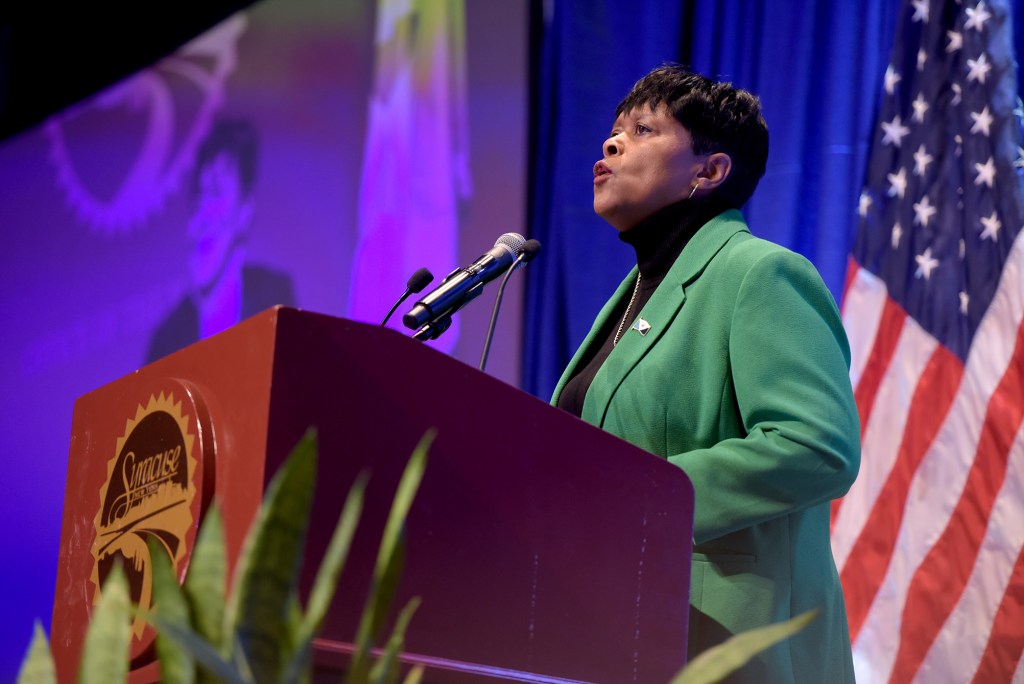
“There are tributes to the original ecology of this region, the memories and many languages and cultures of those who have made this their home, and the symbolism of the circle, signifying a common desire to belong, but also the roots that were taken to come to this place,” Onondaga Historical Association Executive Director Lisa Romano Moore said at the beginning of the presentation.

Creative Urban Academy design
The Creative Urban Alchemy Collective presented the first proposal, a design called “Unity Circle and Heritage Walk.”
The proposed design would replace the current Columbus Circle with a Unity Circle filled with native plants and ancestral plant species, while a Heritage Walk would occupy the vacant Powelson site.
Unity Circle would feature an interactive “Circle of Peace” water fountain that would pay homage to the Haudenosaunee Confederacy’s Great Law of Peace. Across the street, Heritage Walk would feature more native wetland plants and lead visitors past walls built to honor the legacies of Syracuse Italian and Indigenous communities.
The design would seek local artists’ input for ground mosaics to feature throughout the space, which the design team said paid homage to legacy of local Italian-American masonry. Creative Urban Alchemy envisions rotating art exhibitions, farmers’ and artists’ markets, and historical walking tours finding a home in the re-envisioned space.
Ifeoma Ebo, who presented on behalf of the design collective, said the team was inspired by OHA’s oral history archives to include interactive audio stories along the Heritage Walk.
Ebo said during a Q+A session at the end of the event that a visit to the Skä•noñh Great Law of Peace Center was instructive to Creative Urban Alchemy’s approach to modeling a design that honored Syracuse’s past and present with a vision toward its future.
“One of the things we learned there was that you should be like a beaver. You should design like a beaver because a beaver will come in and transform the space and make it better for all living things,” Ebo said during a Q+A session.

Rafael Lozano-Hemmer design
Next, Lozano-Hemmer and his studio presented a video depicting their proposal for a redesigned Columbus Circle, called “Memory Park.”
The designers said that they drew inspiration from Syracuse native Aldo Tambellini, an Italian-American experimental artist credited with popularizing “Electromedia” and other forms of media art.
Memory Park would feature three interactive designs, aimed at changing the space from an area people pass through to one that visitors would choose to spend time in.
“For 30 years, we’ve made anti-monuments. These are public artworks that only exist when people take part, honoring dialog, dissent, and shared experience,” Lozano-Hemmer said.
“Pulse Park” would fill the Powelson site with 3,000 light bulbs,each of which would flash the rhythm of the heartbeat of the last person who touched it.
The bulbs would use little power, are resistant to weather, and would incorporate ultraviolet filters to render their glow invisible to migratory birds, according to the design team’s video. Lozano-Hemmer previously contributed a similar concept as an exhibit at Crystal Bridges Museum of Art in the Ozark Forest in Arkansas.
A 50-foot steel “Voice Tree,” inspired by the Haudenosaunee Tree of Peace, would replace the Columbus monument.
Lozano-Hemmer designed a similar installation for the Buffalo Bayou Park Cistern in Houston, Texas. The tree would allow individuals to approach an interactive station, speak, and hear previous speech from others who have interacted with the tree.
“When you speak, your voice seeks an echo, something that someone said in the past about the same thing,” Lozano-Hemmer said. “… Speak about water, for example, and you hear about water.”
The tree would feature an archive of curated recordings referencing the Haudenosaunee Confederacy, the local struggle for abolition and suffrage, Italian Americans whose families endured discrimination, and more.
The presentation video also stated that, if selected as the winning design, Lozano-Hemmer’s studio would commission local poets, rappers, orators, and elders to provide recordings to the tree as well.
Finally, a small installation called “Syracuse Mirror” would stand at the corner of Montgomery and East Jefferson Street. The piece would feature daylight-bright screens on either side, allowing passersby to look in the digital mirror and see their face overlaid with the faces of people who have interacted with the piece in the past.
The digital mirror would only record people who step into a clearly marked area, and no recordings are stored, the artist said.
“Through your heartbeat, your voice, your likeness, Memory Park becomes yours, mixed with the memory of the city,” Lozano-Hemmer said.

TEN X TEN and MASARY design
TEN X TEN and MASARY Studios presented the final design proposal, called “Living Circles: A Garden of Memory.”
“What if, instead of a monument, we introduce a garden that behaves like a memory?” the designers asked at the start of their presentation.
The design leans into the “full circle” theme of the competition, and seeks to depict the cycles of ecology and history that have shaped the space now known as Columbus Circle. The proposed design would feature two concentric rings elevated above the plaza, holding an array of 1000s of luminaires and suspended by four columns.
A native woodland garden and cedar wetland would surround the sculpture, complimented by limestone benches and columns aimed at “weaving human and cultural stories into an evolving record of place.”
The design studios also incorporated a reference to the Columbus monument in their proposal, which would involve removing the statue from its current location. The monument’s footprint would be marked with rings that would glow during the winter and summer solstices, while the central sculpture itself would use thousands of tubes to offer an interactive experience to passersby.
“The sculpture behaves like an instrument. It’s playable by many forces: wind, sun, humans, seasons, and in its own way, it does what the most powerful cultural objects do: it responds, remembers, it heals, it welcomes,” Ryan Edwards of MASARY said. “When someone touches one of the touchpads, a glowing ring of white light appears in the sculpture. A second touch produces a second ring of light. They slowly move and express themselves before they settle.”
What happens next?
The curatorial committee will announce the winning design proposal in December. Once the contest names a winning design, the city government will have to decide whether to accept the proposal and fund its implementation.
The competition, like nearly a decade of preceding dialogue and debate over the Columbus monument’s future, has prompted controversy and criticism from the Columbus Monument Corporation.
That organization, which is outspoken in its commitment to preserving the Columbus monument in its current setting, declined to engage with OHA and the competition’s curatorial committee to provide input on the competition. Representatives of the organization have alleged that the contest required the statue’s removal as a requisite component of any winning design.
The CMC has pledged to sue OHA for its involvement in the contest, and cited a potential lawsuit as the main reason the organization chose not to participate in the contest.
Despite the monument corporation’s refusal to participate in the competition, St. Paul’s Syracuse Rev. Philip Major at the start of the presentation praised the contest’s focus on inclusivity.
“No one was excluded from the process, and that makes us and the Syracuse community stronger,” Major said.