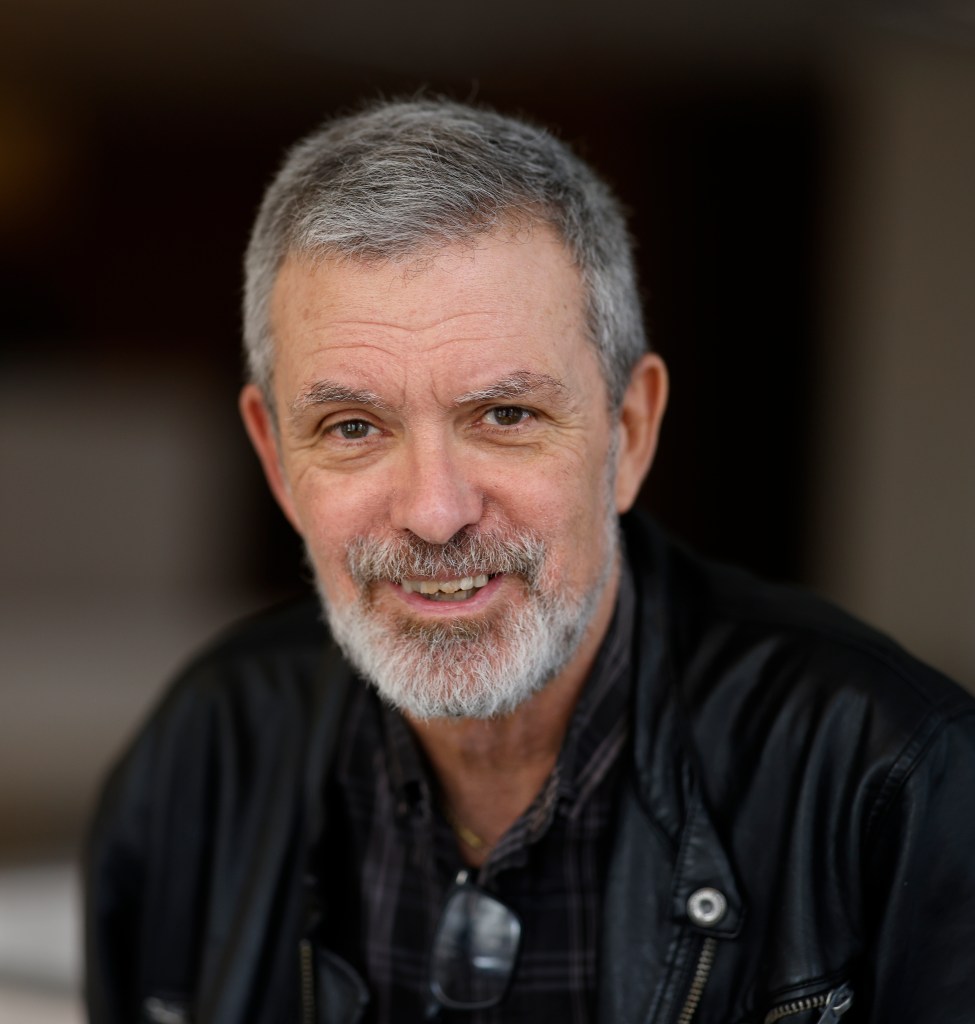
Tim Pickering approached the Council Rock on a cold November day in Canandaigua, called forward by Seneca Nation artist, writer and educator Peter Jemison. With Pickering near his side — a pairing that echoed across at least six generations — Jemison held up some strings of wampum, replicas of a precious gift Pickering knew well.
They are symbols of a “nation to nation” agreement made between the Haudenosaunee and the young United States on Nov. 11, 1794, said Jemison’s son Ansley, speaking of the Treaty of Canandaigua — a treaty both commemorated and symbolized by that boulder.
For Tim Pickering, the wampum was a reminder of a stunning connection, renewed maybe 20 years ago. His family’s foundation in Massachusetts was contacted by a Louisiana family that had held an irreplaceable heirloom for generations, ever since a distant Pickering cousin married one of their ancestors. They were calling because the last descendant of that wedding was ill and dying without any direct heirs, and his relatives wanted “to do the right thing,” as Tim recalls.
They contacted the nonprofit Pickering Foundation, which operates a house museum in Salem, to ask if there was a way to appropriately honor and protect several strings of original wampum of keen meaning, both for the Pickering family and for the nation.
That is how a powerful symbol — the wampum strings that Haudenosaunee leaders gave directly to Col. Timothy Pickering, a federal agent, during long negotiations in the early 1790s — returned to the house where Pickering once lived. It is operated now by a foundation whose board consists of Pickering relatives and community members, including the modern-day Tim Pickering — directly descended six times over from his namesake, the man he calls “the colonel.”
“It’s just so powerful,” Tim said last week, of Canandaigua. He and his wife Wen — joined by Vijay Joyce, executive director of the family foundation — traveled to that Ontario County village for the annual observance of a 231-year-old treaty.
Pickering watched as detailed replicas of those wampum strings were held up and explained by Jemison, flanked by many Haudenosaunee dignitaries. They represented the same enduring Six Nations alliance that gave the original strings to the colonel as a statement of commitment and trust.
For Jemison, who has coordinated the Nov. 11 gathering for decades, last Tuesday’s ceremony felt a lot like a homecoming.

He is 80, while Pickering is 66. Neither could attend last year. Separated by hundreds of miles, they went through simultaneous heart problems that led to both men wearing pacemakers at this year’s gathering. That made their return particularly significant: Jemison, laughing softly, said, “Maybe we were meant to be conjoined.”
As for Peter’s son Ansley, the cultural liaison at the Ganondagan State Historic Site, there was palpable emotion in the sight of his father and Pickering “still standing across from each other, polishing that chain” — an idea personified when the two men held interconnected links.
A history of pain and tumult, contradicting the original promise of the treaty, was recounted by such speakers as JC Seneca, president of the Seneca Nation, and Odie Brant Porter, a Seneca councilor. She described how intrusions like the Kinzua Dam — which flooded 10,000 acres of Seneca territory — and the construction of the New York State Thruway were violations of the words and spirit at the heart of the Canandaigua agreement, concerning specific Haudenosaunee lands:
“ … the United States will never claim the same,” the treaty reads, “nor disturb them or either of the Six Nations, nor their Indian friends residing thereon and united with them, in the free use ·and enjoyment thereof.”
The treaty, Peter Jemison said, establishes “that we’re a sovereign nation, and we will be as long as there are Senecas on Earth.”

On a cold November day, with snow half-covering the bright yellow leaves on the grounds of the Ontario County courthouse, the ceremony began with an annual procession and a short version in Seneca of what Jemison called “the words that come before all others” — an expression of gratitude and thanksgiving offered by Clayton Logan, a Seneca elder.
Many speakers followed — including Haudenosaunee leaders, Canandaigua Mayor Bob Palumbo and an emissary from the office of U.S. Rep. Claudia Tenney — before the event reached its emotional peak:
Grandell Logan of the Tonawanda Seneca territory described how his traditional Haudenosaunee community — bolstered by environmental allies — is fighting plans for a giant data center at the Genesee County Science, Technology and Advanced Manufacturing Park, known as STAMP. The Tonawanda Senecas have gone to court to stop the project alongside the Sierra Club, which shares their fear of ecological corrosion to Indigenous lands and natural areas bordering the massive project.

The 1794 treaty, Logan contends — with its federal promise of “free use and enjoyment” for the Haudenosaunee of their territory — ought to provide direct and indisputable protection, right now.
As the event ended, many spectators expressed quiet pleasure about Jemison’s return. His son Ansley recalled how the remembrance felt “a little bit lonesome” a year ago, when his dad was hospitalized. Peter Jemison described this year’s turnout on a cold day as “wonderful,” and he wished he had a chance to tell every supporter of the treaty just how happy he was to see them there.
Except for his absence last year, Jemison has been a regular at the treaty ceremony since 1987, and he has served as organizer since a monumental 1994 observance of the treaty’s 200th anniversary.
The renewed connection with the Pickerings, he said, began when Vernon Jimerson, a longtime chair of the Canandaigua remembrance, drove to Salem with his wife Carol to put down a wreath on the grave of the original Timothy Pickering. The gesture helped reignite a formal connection the Pickering family reveres — as signified by the 2019 presence at the treaty ceremony of another relative, longtime American diplomat Thomas Pickering.
The present-day Tim Pickering remembers listening as a child while his father, a minister, spoke with grief about all too many broken American promises to Indigenous people — but how his dad found a touch of solace in the lasting resonance of what their ancestor, “the colonel,” helped create at Canandaigua.

“We just knew it was an important part of the legacy of our family,” Tim Pickering said, “and we just wanted to reaffirm it.”
His father was raised in the same house — now a museum — where the colonel lived in the 18th and 19th centuries. Today’s Tim Pickering is the retired operator of a trucking company. He began attending the ceremony in 2016 and has been there many times, though his health prevented him from making the trip last year.
Joyce, the museum director, went in his stead. At Canandaigua, Joyce met Richard Hamell, who taught geology and paleontology at Monroe Community College for 39 years — and in retirement is focused on creating replicas of important wampum. The original beaded belts and adornments were used, as Ansley Jemison put it, as “codified information” of far more lasting diplomatic power than mere words.
The fragile 235-year-old strings returned to the Pickerings are now kept under glass, in the Salem museum. But Joyce sent images last year of those strings to Hamell, who crafted the detailed reproductions that Peter Jemison held aloft last week, just after he asked the present-day Tim Pickering to step forward.
Their side-by-side presence was a living reminder of a long-ago letter they both cite with passion, one sent by Col. Timothy Pickering in 1792 to President George Washington, as the two men corresponded about U.S. negotiations with the Haudenosaunee.

Pickering told the president how Six Nations leaders — recalling attacks by Washington’s forces on Indigenous communities, during the revolution — still described Pickering as an emissary of the “town destroyer.” Their suspicions were intensified, Pickering continued, by a simmering history of guarantees involving their lands, made in bad faith.
“Sir, for your honour & the honour & interest of the United States, I wish them to know that there are some white men who are incapable of deceiving,” Pickering wrote.
Many generations later, the colonel’s direct descendant traveled to Canandaigua as a personal statement on the flesh-and-blood continuity of that 18th century promise — and on the 21st century bonds with the Haudenosaunee, by the Council Rock, that live on within the wampum.
Read more of Central Current’s coverage

Sean Kirst: In Syracuse, in a season for ghosts, Donald Trump collides with legacy of president who served when Trump was born
Seventy-four years ago, on his own campaign visit to Syracuse, Harry Truman described an American landscape powerfully opposite to how Donald Trump portrayed it Friday night.


Trump implores CNY Republicans to ‘pretend’ he is on the ballot ahead of midterms. Will they listen?
President Donald Trump’s visit to Syracuse is part of a nationwide campaign ahead of a critical midterm election that could decide the fate of Republicans in Congress.


New study shows one in four schools in Onondaga County has high lead levels in drinking water
27.3% of the schools in Onondaga County have at least one water outlet in public schools used for drinking or cooking that tested above the state’s standard of 5 parts per billion of lead.

After ‘horseplay’-less budget cycle, Onondaga County Legislature approves 2027 budget and $25 million housing program
County Executive Ryan McMahon had told legislators he would fund their priority project if there was no “horseplay” in the budget cycle. Everybody played along.


Video: The Laurie Woolever interview
Bestselling author Laurie Woolever is interviewed about her experiences covering the restaurant industry and working with Anthony Bourdain.