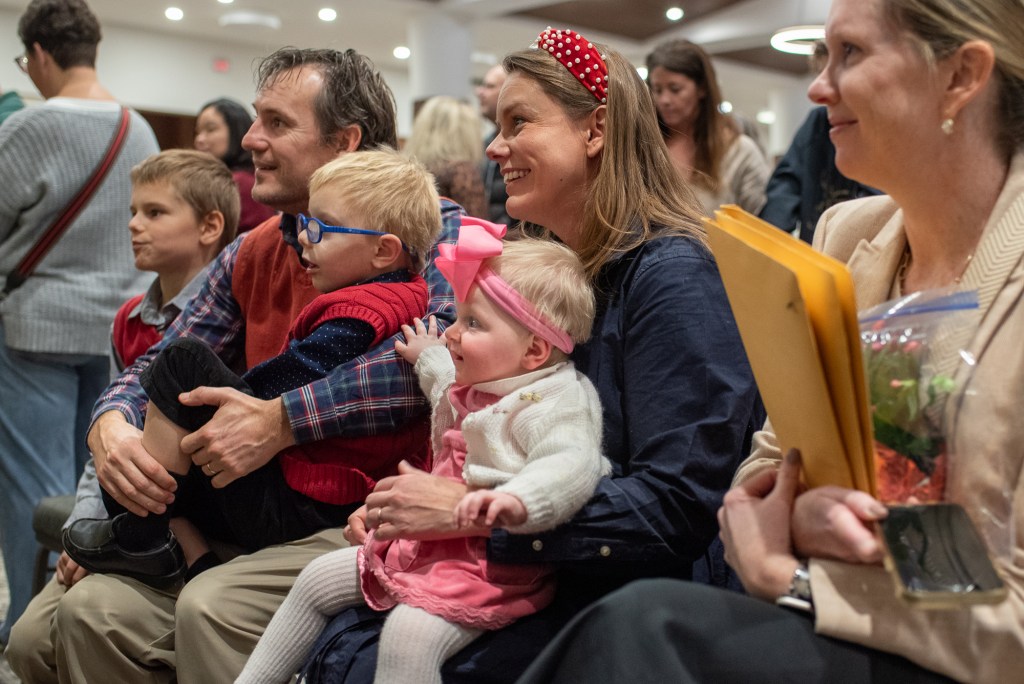
The quick photo at the end wrapped together the whole story. Once a shot clock rededication ceremony on Monday was officially concluded, Rosemary Barboni Kelly, Christian Figueroa and Danielle Biasone Pires gathered for an image — serving as 21st century family emissaries for one of the great tales in basketball history.
They provide living family “testament,” as city parks commissioner Syeisha Byrd put it, to the idea of what genius, belief and diligence can eventually accomplish, anywhere they come together — a truth Byrd wants every child in Syracuse to understand.
The monument, which counts down eternally and digitally from 24, celebrates the 24-second clock — the sports invention that historians agree both saved and elevated the National Basketball Association. For 20 years, that monumental clock was located in a little pocket park on Franklin Street, but the arrival of Crooked Cattle — a restaurant that uses the park as patio space — caused the city to look for a better spot.
From just across the street, Lauren Kochian, executive director of the nearby Milton J. Rubenstein Museum of Science and Technology, immediately said:
“We want it.”
Josh Wilcox, the city planner and landscape designer who oversaw the move, likes the way the clock is now easily visible for several blocks along Franklin Street. The MOST is located in the West Jefferson Street Armory, where the old Syracuse Nationals of the NBA once played, long before they became the Philadelphia 76ers.
The museum hosts an “innovation station” that teaches kids about such born-in-Syracuse bursts of imagination as the world-renowned, foot-measuring Brannock device, and the monument represents “one of the greatest inventions in Central New York history,” as Kochian said.

The city used its own crews to prepare the site, and a craftsman named Devon at the Toltec metalworking shop did a sleek and thorough restoration of the monument, for about $4,000. Monday, the clock formally snapped back on in its new and prominent position at the front entranceway of the MOST, a ceremonial resumption held in the presence of many of the people — or their relatives — who helped bring this one-of-a-kind monument into existence.
The guests included Candace and Derrick Marsellus, wife and son of the late John Marsellus, the philanthropist and Nats fan who quietly donated more than $50,000 – with John Rathbun of the Syracuse Sports. Corp. serving as intermediary — to finance the original monument.
In the crowd were Bob Haley, the architect who designed the all-weather shot clock in 2005, and Pat Driscoll, the then-city parks commissioner who helped weave through many complications to bring it downtown, with the help of former mayoral aide Dennis Brogan. The speakers included Mayor Sharon Owens, who described with passion the clock’s transformative impact “on this game we love so much in Syracuse,” while she emphasized a truth about great and unexpected change that she hopes schoolchildren will appreciate:
“It happened here.”
Twenty-one years ago, the original dedication ceremony for the monument featured four Hall of Fame basketball players, who paid homage to what the clock meant to their game. In attendance were the great center Bill Walton, the tireless John Havlicek of Celtics fame, and Syracuse teammates Dolph Schayes and Earl Lloyd, the first African-American to set foot in an NBA game – both mainstays of the Nats team that won the 1955 NBA title, in Syracuse.
Like Marsellus, those legends are gone now. Monday, the emotional affirmation of the power of the clock really fell to such descendants of the principals as Pires. She said she was thinking of her late father, Joe, namesake of his own dad, and of course her great-uncle, Danny Biasone, an Italian immigrant who ran the Syracuse Sports Center bowling alley Pires recalls so vividly from childhood.

It was “a time capsule,” she said, a place that for decades remained beautifully unchanged from how it looked in 1955. What she knew of basketball since she toddled — the story in the air itself — was how the ingenuity of her coffee-loving great-uncle helped save the game. Danny Biasone was the founder of the Nats, a franchise that originated in the underdog National Basketball League, while Barboni — Biasone’s longtime friend — worked as a scout and administrator with the team.
During World War II, Barboni became close friends with a basketball genius named Howard Hobson — a guy who coached Oregon and Yale and lobbied unsuccessfully for the national college game to embrace a 30-second shot clock.
As for Ferris, he created an NBL club called the Bisons in Buffalo, a squad he moved to Illinois and renamed as the Tri-Cities Blackhawks — and a team that survives today as the Atlanta Hawks. When the NBL and the wealthier Basketball Association of America waged a fierce 1940s war for survival, Ferris became NBL president and the league’s strategic warrior, which made him one of the central figures in the 1949 merger that created the NBA itself.
Figueroa said his great-uncle, homesick for his family in Upstate New York, settled in Syracuse to serve as the Nats general manager. He joined Biasone in building a fast and talented team. But they also realized the game itself was creating a major problem: Stalling tactics and slowdowns made the NBA tedious to watch and kept the fans away.
Ferris, Biasone and Barboni saw an answer. They considered Hobson’s solution and decided to rework it for the pro game. Longtime Post-Standard sportswriter Jack Andrews remembered Ferris and Biasone doing equations on a napkin at the bowling alley. They proposed a 24-second shot clock to speed up the sport, and they tried it out for other NBA owners and team executives in a 1954 scrimmage at the old Blodgett Vocational High School, Biasone’s alma mater.

The league agreed to give the idea a try.
In 1954-55, using the clock, NBA scoring went up by more than 13 points a game.
The Nats – trailing badly to the Fort Wayne Pistons in the seventh game of the championship series – used the clock as a way to rally and win it all.
The NBA took off, success that increasingly made it more suited to major cities. In 1963, the Nats said farewell to Syracuse, relocating to Philadelphia. They left behind a profound legacy, a point made with particular emphasis by a longtime NBA historian, Bill Himmelman, who once told me there are two key moments in basketball history:
The day Dr. James Naismith nailed a peach basket to the wall — and the day the shot clock was turned on, in Syracuse.
Monday afternoon, Rosemary Barboni Kelly and Figueroa and Pires stood arm-in-arm by the clock and thought about their families and the meaning of the monument, how a few guys leading everyday lives in Syracuse in the 1950s brought about an innovation that turned the NBA into today’s multi-billion-dollar colossus.

Kelly said Barboni – her uncle – was always humble and low-key, a warm and soulful guy who deserves the recognition. Pires reflected on the deep family pride involving Biasone, an immigrant child who grew up to change the course of a major professional sports league.
And Figueroa spoke of how Ferris, his great-uncle, died of Huntington’s disease – an illness that stripped him of his ability to tell his own story. The same illness took the life of his daughter Jamie, who always joined her late mother Beverly in advocating for recognition for Ferris and his legacy, leaving Figueroa — who drove from Boston for Monday’s ceremony — to relate how his family remains focused on a great quest:
Ferris created the Hawks, an NBA franchise that’s still rolling. He was an undisputed founder of the NBA, seated at the table with other principals in the Empire State Building on the day the league was created. Ferris helped build an NBA champion in Syracuse and was directly involved with the decisions and rule changes that transformed and saved the pro game at its most vulnerable point.
In the same way as Nats legends Biasone, Schayes and Lloyd and their great coach Al Cervi, Figueroa believes Ferris ought to be on the wall in the Naismith Memorial Basketball Hall of Fame, in Springfield.
The shot clock monument, then, provides affirmation for his family that is almost beyond words.
In Syracuse — in a message that Kochian, the museum director, described as uniquely suited to the MOST — the tale offers an enduring statement about possibility. As Owens pointed out, the generational lesson of the monument for every girl and boy is a reminder of how great achievement can occur anywhere with belief and diligence and guts, even when few others see it coming.
“We’re psyched to have it,” Kochian said, because the shot clock scores those points.
Read more of Central Current’s coverage

County Sheriff candidates Shelley and Lenhart claim they each have more relevant “experience” to run the department. How do they plan to do it?
Candidates for Onondaga County Sheriff discussed moving the county jail operations to a joint campus in Jamesville, progressive discipline, opioids, and immigration in interviews with Central Current


2026 Election Q&A: New York State Assembly 126th District candidate John Lemondes
Assemblyman Lemondes, a Republican, will look to retain his seat for a fourth term in Albany, facing off against Democrat Ian Phillips in November.


2026 Election Q&A: New York State Assembly 126th District candidate Ian Phillips
Democrat Phillips is seeking to unseat Republican Assemblyman John Lemondes who is on his third term in Albany.

Scenes from rally day
On the day of President Trump’s visit to Syracuse, the competing sides agree on one thing: the American system is rigged against the people. They disagree, however, on who’s to blame.


Trump’s speech casts a long shadow
For himself and his allies, President Donald Trump has pushed the limits of acceptable political expression. For his opponents, Trump has pushed suppression and surveillance of free speech.