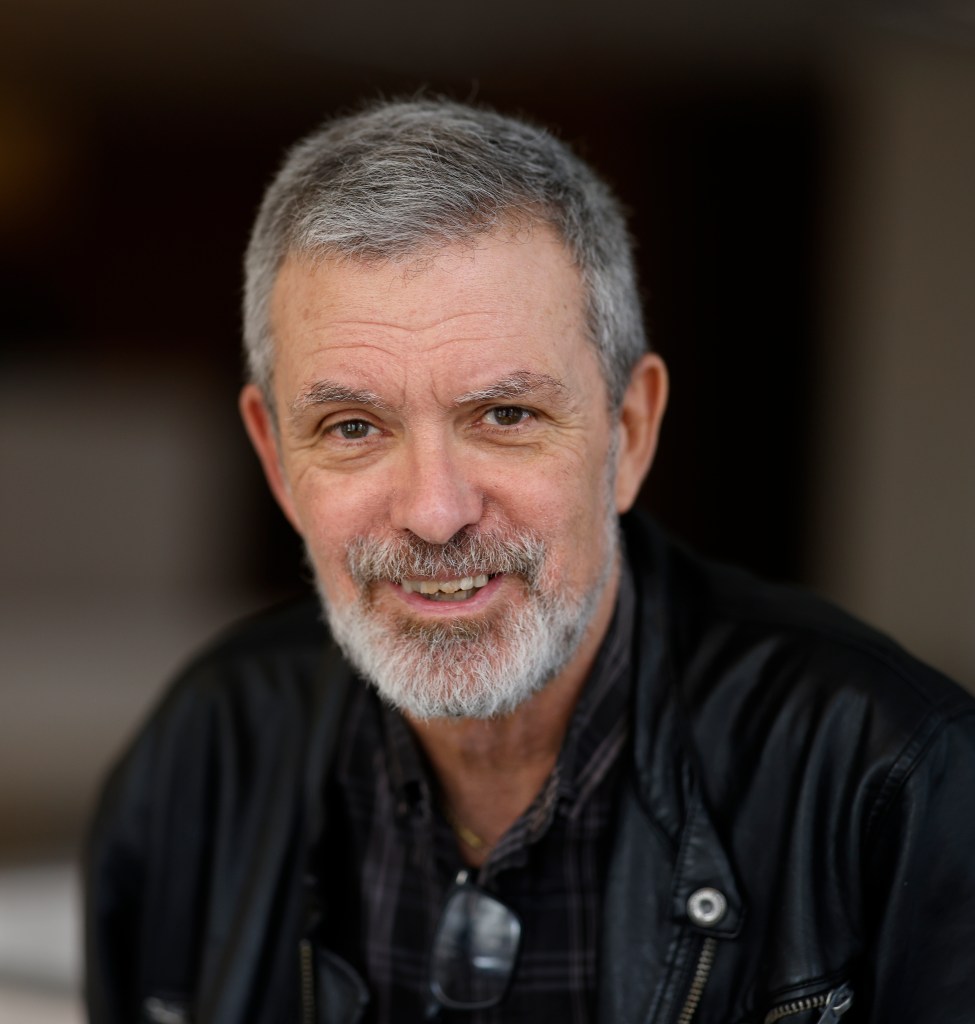
I arrived in Syracuse in 1990 after a couple of years of reporting at a bureau in Oswego. I cannot remember a single time in the last 35 years when Ken Jackson wasn’t a journalistic presence in this city, which only escalates the sadness and disbelief over his death last week.
What I do remember vividly is when our connection changed from professional courtesy to a level of real friendship, and that was due to a legendary Syracuse journalist named Emanuel Henderson Sr.
More precisely: Throughout the city, with respect and affection, Henderson was known as Emo.
Decades ago, there was a newspaper in the Black community called The Progressive Herald. Emo — a guy whose lifelong hunger for books and libraries began in childhood — was a skilled and fiery columnist for that paper for many years after World War II, an era when he had zero chance of being hired by any of the all-white mainstream papers. His columns were raucous, gossipy and courageous: If Emo saw cruel and casual racism hurting Black taxi drivers, he called it out. At a time when husbands could get away with assaulting their wives, Emo threw a spotlight on that violence.
His focus was the human drama of the old 15th Ward, before it was lost to Interstate 81 construction — done in by this what-were-they-thinking bureaucratic hope that prosperity would somehow blossom from widespread demolition. Emo lived a long life – an extraordinary guy who still swam laps deep into his 80s, a guy who in a different world and time would have been a journalist whose career and legend extended far beyond Syracuse.
Not too long before Emo’s death at 90 in 2010, I supported an ultimately successful effort to lift his name onto the Syracuse Press Club Wall of Distinction, correcting what seemed like an egregious historical oversight. The goal was doing it while Emo had a chance to see it. Jackson — both as a longtime publisher, editor and columnist for of Urban CNY (The Constitution) and as an SPC board member — made a point to me at the time based on Jackson’s own life and achievements, and his deep knowledge of his city:
Emo deserved to be on the wall, certainly. But so did the late J. Luther Sylvahn, who published The Progressive Herald and gave Emo and other Black journalists a place to work — and a larger voice — when almost every establishment door was locked against them. It was much to the joy of both Jackson and Emo, then, when Sylvahn’s name was added a year later to the wall, and Jackson offered a quote to The Post-Standard that said it all:
“Without him, there’d be no me.”
Writing this, I think Jackson would be pleased to see his name in the same sentence as Sylvahn’s, one of his heroes. I remember Jackson as a warm and thoughtful guy who was also a magnificent and formidable contrarian on what he saw as all-too-easily accepted civic wisdom. He relished digging in for a great debate.
And I am deeply grateful to the SPC for making sure this champion of all-too-often-overlooked African-American neighborhoods — this journalist who gave so much of his adult life to the profession — had the chance to see his own name go up on that Wall of Distinction, in 2023.
We had countless conversations and messaging back-and-forths over the years — until the city finally started plowing sidewalks, for instance, we shared a belief that the snowiest large city in the nation shouldn’t ignore pedestrians trying to trudge through knee-deep snow — but I think the passionate theme that will always stay with me is Jackson’s high and adamant threshold for what it will take to make a real success of the multi-billion-dollar removal of the I-81 bridges.
In his earliest years, as his sister Tami said, Jackson lived on Renwick Place in the old 15th Ward. Throughout his life, he never forgot the collective feeling of what the neighborhood once was. I can remember how Jackson often ruefully cited the perky civic language and promises that officials chirped like bird song during the massive 1960s demolition caused by I-81 — a project the newspapers casually described as “slum control” — with its dreamy visions of how families forced out of their homes would somehow move into better quality housing.
Instead, Jackson said, many of those families were eventually pushed into grim developments like the now-razed Kennedy Square. The aura of hard-won community was shattered and replaced by lives lived in passages through concrete hallways. In that sense, the damage was still cascading until the day he died.
So Jackson reacted warily to early community discussions about spending billions to pull out I-81, and raised his eyebrows at all the projections about how the initiative might intertwine with potential benefits for families just south of downtown, already living near its footprint.
During a memorable 2019 WCNY roundtable discussion with journalist Susan Arbetter and several civic officials, Jackson passionately laid out his concerns:
He worried about “underwriting people out of the equation.” He spoke of the sky-high broken promises of Urban Renewal, and how “60 years later, we’re still waiting.” He said “the common person who is not linked to a power source is (too easily) excluded,” and he made this one gesture toward hope:
“I believe this can work,” he said of visions for a better city, after the I-81 project, “but it has to be done differently.”
He died on April 23 at 67, after what his sister described as a short illness, and he did not live to see exactly how any of this will play out.
Jackson’s calling hour and services begin at 11 a.m. Friday, at Hopps Memorial CME Church on South State Street. In the weeks and months to follow, there will be much discussion about how best to honor Jackson, whose absence will be palpable at Saturday’s annual press club awards dinner.
Yet the greatest of all tributes is also the hardest one: Jackson and his Urban CNY had closely tracked every step of both the I-81 project and the sprawling nearby long-term housing plans, and his relentless mission was making sure such sweeping change was to the benefit of those who have the least.
Only weeks before his death, Jackson was writing about the recent turbulence threatening the proposed $32 million Children Rising Center — keystone of a $1 billion plan to create a new neighborhood along East Adams Street — and the delicate attempts to give that staggered project a second chance.
The most significant memorial, then — and the one that likely would matter most of all to Jackson — seems obvious. Beyond all the accounts of nose-to-nose frustration within public leadership, at this potentially generational moment of transformation, the central civic players need to make a herculean effort to break the patterns of Syracuse conflict and inertia Jackson wearily observed as being all too often inevitable, throughout his life …
And this time, with Jacksonian tenacity and ferocity when so needed, do this right.
Read more of Central Current’s coverage

New study show one in four schools in Onondaga County have high lead levels in drinking water
27.3% of the schools in Onondaga County have at least one water outlet in public schools used for drinking or cooking that tested above the state’s standard of 5 parts per billion of lead.


After ‘horseplay’-less budget cycle, Onondaga County Legislature approves 2027 budget and $25 million housing program
County Executive Ryan McMahon had told legislators he would fund their priority project if there was no “horseplay” in the budget cycle. Everybody played along.


Video: The Laurie Woolever interview
Bestselling author Laurie Woolever is interviewed about her experiences covering the restaurant industry and working with Anthony Bourdain.


2026 Election Q&A: New York State Assembly 129th District candidate Maurice ‘Mo’ Brown
Brown, a Democrat, faces Republican Shawn Fiato in the race for the seat. The Democrat challenger took down longtime incumbent Bill Magnarelli in the Democratic primary in June.


Sean Kirst: Jim Gifford’s life equaled faith in Elmwood. Saturday’s cleanup, in his memory, nurtures that spark.
An annual gathering in honor of a guy, lost to violence, whose everyday world represented full neighborhood commitment.