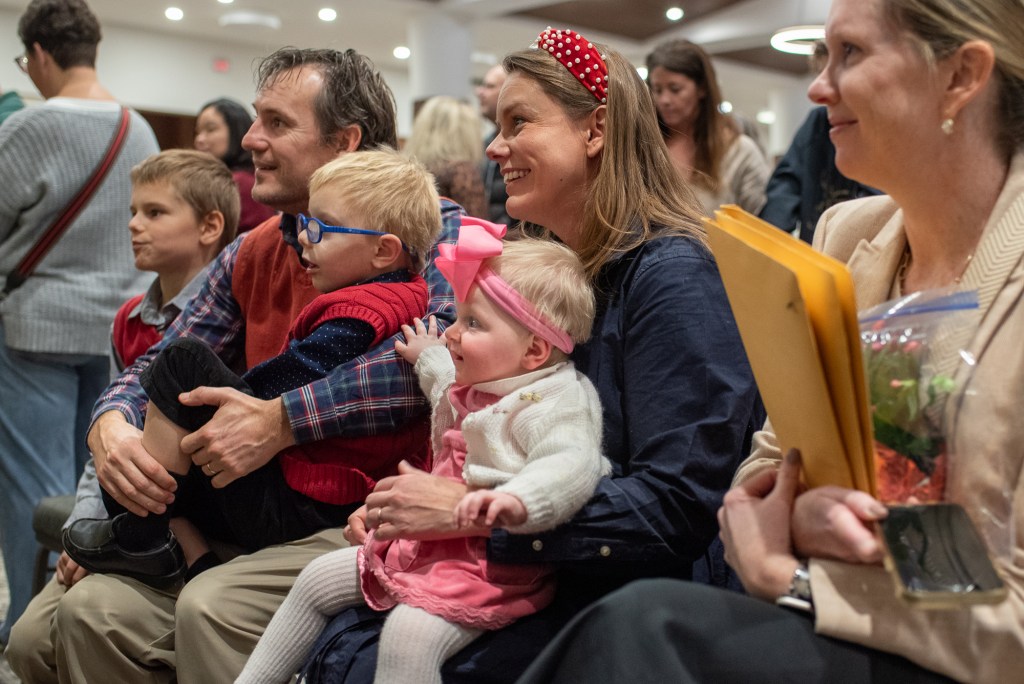
Parents and community members on Monday rallied in support of Dahlia Saada, a Palestinian American student at Fayetteville Manlius High School who said she has felt singled out by district officials following her recitation of the poem “If I Must Die” in May.
Fahed Saada, Dahlia’s father, and two other community members said at the district’s board of education meeting Monday the district has failed to properly reckon with an uncomfortable conversation: Israel’s ongoing killing of Palestinians in Gaza.
Dahlia read the poem by Refaat Alareer at a school assembly directed by the Asian American and Pacific Islander club in May, after feeling moved by a student’s reading of a poem on the keffiyeh the year prior.
In a statement one day after the reading of the poem, Principal Patrick McNamara called the poem “politically charged” and noted that school assemblies are not a place for political advocacy. Community members speaking at the board meeting called the email statement improper.
McNamara wrote that the district heard from members of the community about the poem, but did not elaborate on what the concerns were or who expressed them.
Later that week a video of a person who parents identified as an FM High student desecrating a Palestinian flag emerged online. The district did not issue a public statement on the video’s existence, prompting parents, including Fahed, to call the difference between the district’s reaction to the poem’s reading and the existence of the video a double standard.
A group of about 30 district families emailed the district demanding two things: a retraction of the principal’s email about Dahlia’s poem, and an apology that includes a condemnation of the Palestinian flag video.
Kelly Price, the mother of an incoming F-M High freshman, said at the meeting she wished the district would allow students to speak about the killings of Palestinians in Gaza with the same freedom as speakers did during a Holocaust Remembrance Day presentation in January.
“I do believe that F-M has done harm by stating that we can memorialize and talk about dead, for example, in Holocaust Memorial Day, which was important, and my son got a lot out of that, and not talk about other cultures’ dead on a cultural heritage day,” Price said in reference to Dahlia’s poem reading. The epilogue to Dahlia’s recitation included estimated death tolls of Palestinians since Oct. 7, 2023.
Community members’ comments at the meeting come after the district did not address some parents’ demands by the parents’ deadline of May 26.
In an inquiry to F-M Central School District Superintendent Magda Parvey, Central Current asked if the district plans to adhere to those demands and the accusations of a double standard when it comes to the poem and the video. Parvey said the district’s stance on the matters has not changed since the last Central Current inquiry made on May 27.
She offered the same statement as she did then:
“On May 19, F-M High School issued a communication to families regarding an assembly held at the high school. It addressed the district’s review process for student-led assembly content, not any individual student. The district stands by that communication.
As stated then, the district does not take positions on political situations, and school-sponsored assemblies are not the venue for political content of any kind, regardless of the viewpoint expressed. The district’s review process was not followed in that instance, and we have been addressing that procedural matter.
I have heard from families and community members in the days since, and I have responded to those who have reached out to me directly. I take these matters seriously, and I am committed to ensuring that our students feel safe, supported, and valued.
When incidents are reported to the district, they are addressed through our Code of Conduct and the Dignity for All Students Act (DASA) process where appropriate. Again, the district does not make community-wide statements regarding student discipline. Due to student privacy laws, I am not able to comment on individual student matters.
F-M is one community. I continue to engage with interfaith organizations and community leaders to help us navigate these challenging moments and to support our students through them.”
At the Monday meeting, former Syracuse University professor Mara Sapon-Shevin, said the district failed its own mission statement of including people from all social and cultural backgrounds with its response to Dahlia’s poem reading.
Sapon-Shevin, who is Jewish and has done research and written books on inclusive education, recommended district leaders participate in inclusion training.
“This was a fail,” she said. “It is important to make a distinction between criticism of Israel and the policies and what’s going on in Palestine and Gaza and anti-Semitism. It is one of the teachable moments for the district, to make a distinction between what’s anti-Semitism, what’s Islamophobia, and what’s a conversation that’s uncomfortable that we should have.”
As parents look for a response to their demands, Fahed said his message remains clear: he thinks the district condemned his daughter’s reading of “If I Must Die.”
“You’re condemning our daughter’s poem, that is really putting a stain on her school, when it was approved,” he said. “You allowed her to say it and then threw her under the bus. You’re supposed to stand up for your students and not just please certain community members or families that complained.”
Read more of Central Current’s coverage

Onondaga County elections guide 2026
Central Current has prepared a paywall-free election guide to help inform you about the candidates and issues shaping each race.

2026 General Election Q&A: Onondaga County Legislature 14th District candidate Jessica Dapson
Democrat Jessica Dapson is running to represent the legislature’s 14th District. She faces Cody Kelly in the race for the seat.

2026 General Election Q&A: Onondaga County Legislature 2nd District candidate Matt Jones
Democrat Matt Jones is running to represent the legislature’s 2nd District. He faces Kevin Meaker in the race for the seat.
2026 General Election Q&A: Onondaga County Legislature 15th District candidate Jo Bennett
Democrat Jo Bennett is running to represent the legislature’s 14th District. They face Woodruff Carroll in the race for the seat.
2026 General Election Q&A: Onondaga County Legislature 17th District candidate Laura Lavine
Republican Laura Lavine is running to represent the legislature’s 17th District. She faces Majority Leader Nodesia Hernandez in the race for the seat.