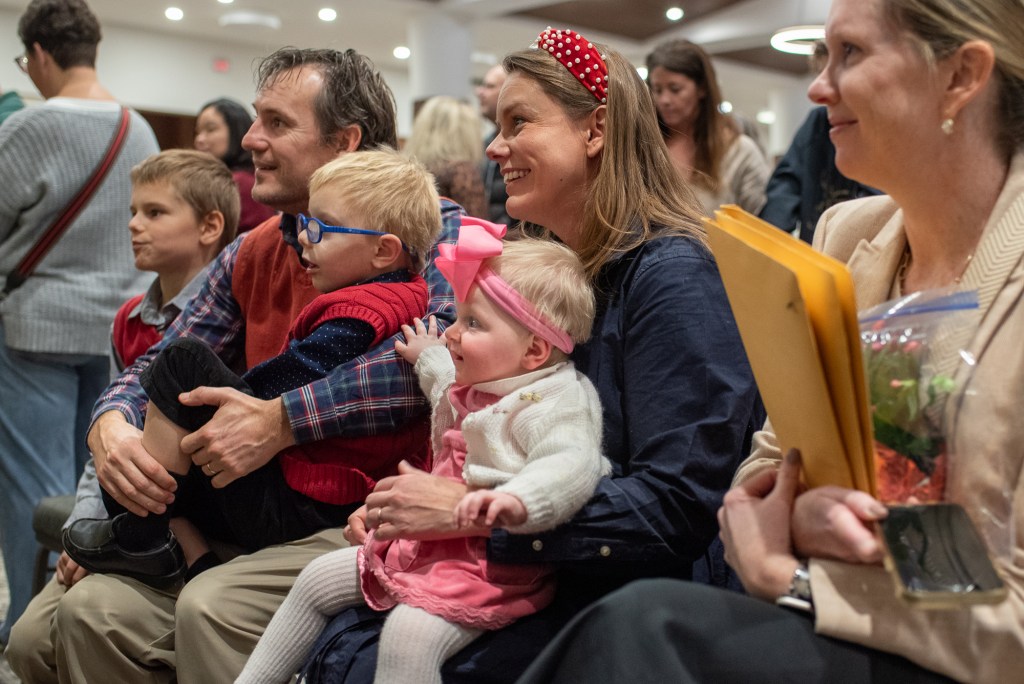
Central Current hosted a panel discussion Monday at ArtRage Gallery detailing solutions to Syracuse’s growing housing crisis.
Panelists Alex Lawson of CNY Fair Housing, Sylvia Espinosa of the Volunteer Lawyers Project, and Syracuse city auditor Alex Marion agreed that the city must prioritize the interests of tenants over landlords.
The speakers emphasized the need for more housing and more code enforcement, along with fewer rent hikes and more tenant protections. They pointed to stark statistics that reflect the housing crisis, such as a 150% increase in homelessness in Central New York since 2019. Syracuse’s children have been hit especially hard by this homelessness hike; roughly 10% of Syracuse City School District students face homelessness, and nearly 1 out of 2 city kids are below the poverty line.
An ongoing exhibit from Central Current contributing photojournalists Michelle Gabel and Michael Greenlar, called “A Place to Call Home,” served as a backdrop to the housing discussion. Gabel and Greenlar spent a year documenting Syracuse residents’ attempts to navigate the housing crisis.
Central Current executive director Maximilian Eyle and Central Current contributor Eddie Velazquez hosted the panel discussion on Monday at the ArtRage gallery.
Velazquez began the discussion with a breakdown of the increase in median rent in Syracuse since last February. The median rent in Syracuse is now about $1,230, a 17% increase since last February.
Syracuse’s rent increase is a national outlier; in 2024, rent increased in Syracuse by 22% – the highest rate increase of any city in the United States.
Lawson explained that while consistent rent hikes erode housing stability for all residents, it is the community members who already live on the margins that are most affected.
“The deleterious effects of housing conditions, of rent increases, are falling hardest on the people who have been victims of discrimination for decades in our community,” Lawson said. “That’s people of color, it’s women, it’s families with children.”
The panelists then outlined what Marion called a “three-legged stool” of solutions: tenant protection, code enforcement, and more housing. The first two solutions are aimed at improving the quality of current housing for residents, while the third will provide more options to renters and could slow the rate of rent increases, according to the panel.
Protecting tenants
The panelists presented a uniform call for the city to pass “good cause eviction” legislation to protect tenants from retaliatory evictions and untenable rent increases.
“Good cause eviction” is a New York State law that cities like Syracuse can choose to implement.
The legislation would:
- Force landlords to provide in court a “good cause” to evict tenants
- Could contest at eviction hearings rent increases above 10% of the yearly rent or 5% plus the rate of inflation, whichever is lower (a judge can overrule the tenant’s contest if the judge deems property expenses or repairs warrant a higher rent increase)
- Force landlords to provide in court a “good cause” to not renew tenants’ leases
“Good causes” include lease agreement violations, non-payment of rent, negligent damage to the premises and unreasonable refusal of access to the property for necessary repairs.
Marion said the city needs to stop prioritizing the interests of landlords, because 60% of Syracuse residents are renters. While discussion with in-city landlords is important, Marion said, the majority of Syracuse landlords are not city residents.
“They are faceless PO boxes that we can’t track down,” Marion said.
The panel took aim at the Common Council’s qualms on “good cause.” Marion pointed out that, though the councilors invited landlords to share their perspective at a hearing, tenants have not yet received any such invitation.
Lawson dismissed councilors’ frequently expressed concerns that adopting “good cause” legislation will cause landlords to stop investing in the city.
“If you look around Syracuse, and you look at the condition of the housing, we don’t need this kind of investment,” Lawson said. “This is not a successful approach to fixing housing conditions in Syracuse, is getting slumlords in here.”
While the Common Council continues to consider adopting “good cause” legislation, tenants have a few existing protections to leverage against an eviction proceeding, according to Espinosa, the attorney with the Volunteer Lawyers Project.
Tenants can file for rent payment assistance through the Onondaga County Department of Social Services. Section 8 caseworkers can also assist tenants facing eviction. Tenants facing uninhabitable living conditions can also sue their landlords.
Espinosa reiterated that these tenant protections do not prevent landlords from evicting tenants.
“That’s something that the landlords don’t understand,” Espinosa said. “It doesn’t mean that they can stay there forever. The eviction can still happen.”
Enforcing violations
Of the city’s 35,000 residential properties, 33% are in a state of disrepair. Over half of these properties are outside of compliance with the city’s rental registry standards.
Meanwhile, 20,000 code violations reported by Syracuse tenants remain active.
The rental registry could be a productive tool, if used properly, panelists said. The registry is intended to keep track of all the one- and two-family rental properties throughout the city, which in theory keeps the city abreast of the conditions and potential code violations in all Syracuse rental units.
The rental registry can ensure landlords understand their responsibilities and their prospective tenants’ responsibilities, Marion said. By requiring landlords to register their properties with the city and pay a fee for a codes inspection, Marion said the city also creates open lines of communication with landlords for policy updates.
But only one quarter of all the properties in Syracuse are currently on the registry, Marion said. While this may explain some of the open code violations, it also means the city is not creating revenue to invest back into stronger code enforcement.
Marion is not in favor of raising the current rental registry fee, which costs landlords $150 every three years, but he is in favor of increasing landlord compliance to achieve the registry’s full potential.
“We need to make sure that code enforcement is a revenue generator for the city of Syracuse,” Marion said, “so that money can go right back into strengthening the resources we have to keep tenants in their apartments and their homes really safe.”
Creating housing
Syracuse residents don’t have enough housing options, Lawson said.
To get more options, Lawson argued investment from out-of-city developers is crucial.
Lawson explained that he sees a difference between out-of-city developers investing in the community, versus out-of-city landlords extracting from the community.
“It’s a good thing that someone from somewhere else is pouring money,” Lawson said.
Multi-story housing projects throughout the city would give renters options while increasing population density, according to Lawson. To do this, Lawson said, the city must become more open for the construction of two-family homes.
Resident Peter McCarthy, of the CNY Solidarity Coalition, railed against out of town landlords.
“They don’t live in the city,” McCarthy said. “They might live in our suburbs, they might live in another country. And they’re taking money out of this city.”
Read more of Central Current’s coverage

Trump implores CNY Republicans to ‘pretend’ he is on the ballot ahead of midterms. Will they listen?
President Donald Trump’s visit to Syracuse is part of a nationwide campaign ahead of a critical midterm election that could decide the fate of Republicans in Congress.


Trump’s pitch to Central New York: Despite war, rising prices, a ‘golden age’ in America
The president spoke in Syracuse about New York energy, his own successes and the unfairness of the Nobel Prize Committee.


New study shows one in four schools in Onondaga County has high lead levels in drinking water
27.3% of the schools in Onondaga County have at least one water outlet in public schools used for drinking or cooking that tested above the state’s standard of 5 parts per billion of lead.

After ‘horseplay’-less budget cycle, Onondaga County Legislature approves 2027 budget and $25 million housing program
County Executive Ryan McMahon had told legislators he would fund their priority project if there was no “horseplay” in the budget cycle. Everybody played along.

Video: The Laurie Woolever interview
Bestselling author Laurie Woolever is interviewed about her experiences covering the restaurant industry and working with Anthony Bourdain.