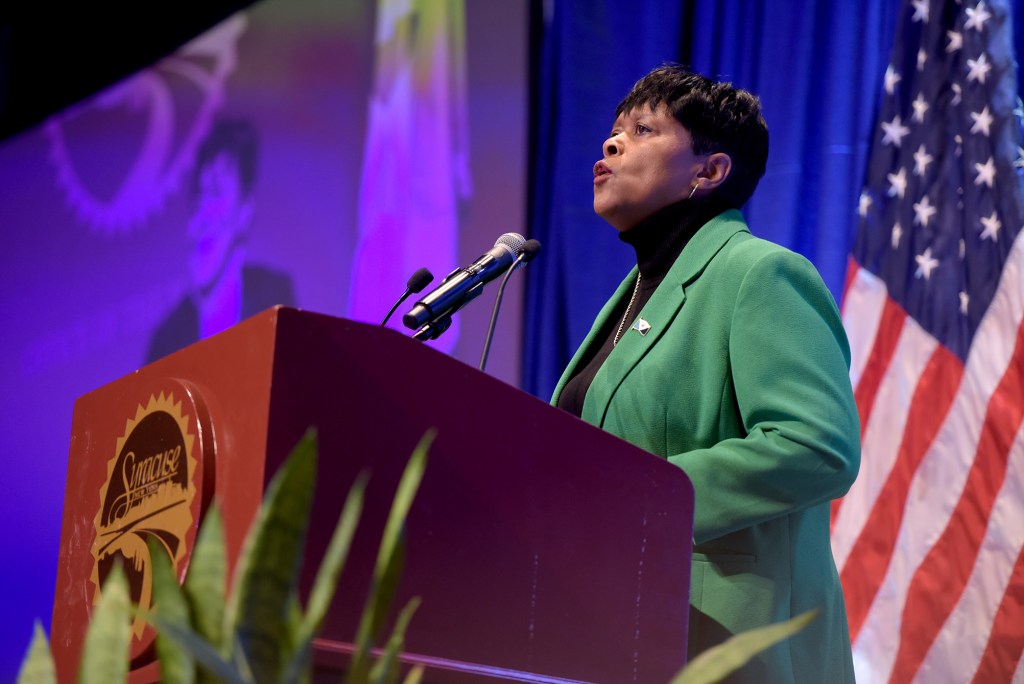
The Onondaga County Legislature voted today to exempt veterans who are “permanently and totally” disabled by their service from paying county property tax.
Ricky Mills, the commander of the American Legion in Camillus, said it was a “small victory” and that the big fight would be getting school districts to do the same. But he had tears in his eyes as he talked to Central Current after the legislation passed.
“Imagine this happened all the way across the state,” he said.
The local law was sponsored by David Knapp (R-Lafayette), who is himself a veteran.
“I served with a lot of Vietnam veterans in the ’80s who were still in service, so I certainly have an appreciation for their service and their sacrifice for us,” Knapp said. “And so I think this is the least we can do for especially someone who is 100% disabled by their service.”
Knapp said shortly before he talked to Central Current, he’d gotten a voicemail from a veteran saying that the bill could be a “lifesaver.”
Permanent and total disability status is assigned to veterans by the Department of Veterans Affairs. Total disability status is determined for the purposes of compensation. It is applied automatically to certain veterans – those who lose both eyes, or hearing in both ears, for example. Otherwise, the VA uses mathematical calculations to add up combinations of disabilities to determine a rating. To be considered permanently disabled, these disabilities must be unlikely to improve.
Not all veterans are willing to apply for disability. Charles Iavarone told Central Current he had refused to apply for disability for 12 years after discharge. He didn’t want to take a handout, he said.
Iavarone believes “disability” is a misnomer for VA compensation.
“If you get hurt at your employer, you can sue your employer,” he said. “I was not eligible for that. I could not sue them for the toxic exposure. I could not sue them for any of the injuries. I could not sue them for the repeated traumatic experiences. That was never an option.”
The VA compensates people with total disabilities at a rate of $4,000 per month. Some permanent and total disability veterans are unable to work, while others still can.
Knapp has been hoping to pass the bill since New York made it possible last year. Governor Kathy Hochul signed a bill into law on Dec. 19, 2025, that allowed local jurisdictions to exempt veterans from paying these property taxes. Because of New York’s home rule laws, the state is unable to apply the law universally.
The exemption will take effect in 2028, as the 2027 tax rate has already been set, and will only apply to county property taxes. If a county or school district wanted to apply the same exemption, they would have to vote separately to do so.
Veterans will have to apply for the exemption with their local municipal assessor. They must have a discharge other than dishonorable or bad conduct, and they must have evidence that they are totally and permanently disabled as a result of their service. If they move, they will have to reapply from the new location.
Veterans have a higher homelessness rate than the rest of the country and a higher suicide rate as well. In a public comment to the legislature, Mills said that the exemption was a tiny part of making sure the county didn’t contribute to the 22 veterans a day who take their lives.
Iavarone said that when he started pushing for the legislation to pass, he did not have permanent and total disability designation. Now, he does. But his push is about other people, he said. Iavarone works in Emergency Medical Services and says many of the homeless people he sees are veterans. He believes that limiting the costs associated with housing will help reduce veteran housing insecurity.
Mills has P&T status himself due to a traumatic brain injury, but says he is able to mentally attend these meetings on behalf of veterans who can’t. Many veterans self-isolate.
The county’s property tax rate in 2027 will be $2.67 per $1,000 of assessed value. That means residents would pay $534 in county taxes on a $200,000 home.
At a Ways and Means committee meeting in October, the county’s chief financial officer, Kristi Smiley, said the county does not know how many people would qualify for the exemption, as it doesn’t yet collect information on those people. However, she estimated the cost to taxpayers to cover the exemption would be an extra $1 per year in taxes on a $200,000 home.
The bill passed the legislature unanimously, with nearly all the members co-sponsoring it. But a bulk of the money on a property tax bill goes to school districts. Knapp encouraged his fellow legislators to speak at school board and town board meetings to convince them to pass similar laws.
Minority leader Brian May said he hoped the county’s example was a “call to arms” to school districts.
As of Oct. 28, the last time the Department of Veteran’s Services list was updated on their website, several cities, towns, and villages, including the nearby city of Auburn, had adopted the law. Monroe was the only other county in New York to have adopted it. Two school districts in the state – one on Long Island and one in the Adirondack region – have adopted the law.
“It’s not a silver bullet,” said Maurice “Mo” Brown, another legislator who is a veteran. “This isn’t, ‘Hooray! We’ve made it so veterans can afford to live here!’ This just makes it a little easier.”