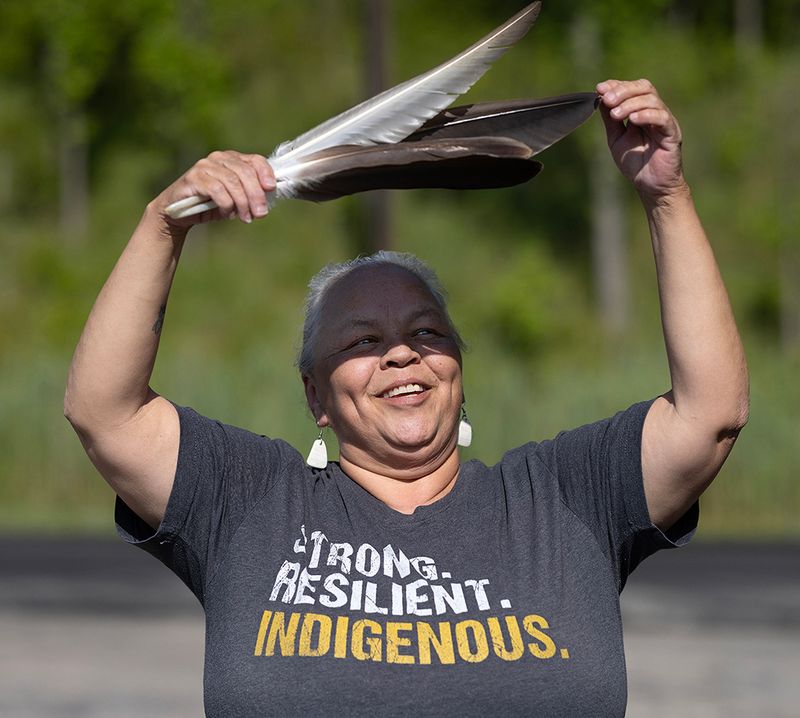
Lis Webber had a dilemma earlier this year: She’d gone grocery shopping just a few days before an out-of-town trip and didn’t know what to do with the fresh food she’d just bought.
Webber turned to Google and searched: ‘community fridges in Syracuse.’ After living in New York City for a decade, Webber assumed community fridges existed everywhere.
“My Google search results led me to a lot of wonderful organizations but nowhere that was able to accept fresh produce or fresh food, and that was kind of shocking,” Webber said.
The search inspired Webber, a Central New York native, to create a community fridge, where anyone can drop off perishable food that others can pick up.
Webber was also inspired by the number of people in the area who face food insecurity. Based on a May 2024 report conducted by CNY Vitals, 9.7% of all Onondaga County residents face food insecurity. The study found that 17.3.% of children face food insecurity.
“Food is a basic human right,” Webber said.
Syracuse residents can expect to see the first installation of the Syracuse Community Fridge as early as next year.
After months of meeting with local groups and potential host locations, Webber found a local host partner and location on the campus of All Saints Church at 1340 Lancaster Ave.
She plans to replicate a similar community fridge concept that is used across New York City, where she lived until recently moving back to the Syracuse area. Webber is hoping to install community fridges in food-insecure neighborhoods in the future and increase accessibility to fresh produce in the cities’ most vulnerable areas.
Volunteers will help Webber run the community fridge, she said. Webber wants to also work with other organizations, including Kitchen Literacy Project and West Pond Alliance.
“The community fridge movement had been so beneficial during the pandemic in the United States that I just thought that my community could benefit from it, as well,” Webber said. “I wanted them to have the opportunity to have one.”
Why Webber is creating a community fridge
When Webber lived in New York City’s East Village, she volunteered with community fridges across the city. She worked with Artists, Athletes, and Activists, One Love Community Fridge in Brooklyn, and Overthrow Community Fridge in Manhattan.
Webber wanted to see people in her hometown get the same advantages community fridges offered New Yorkers.
“It’s dignified, it’s respectable, it’s beautiful and it’s inviting to use and to participate with,” Webber said. “Even if you’re not engaging with the fridge and you see it, then I hope it would be thought-provoking, and start conversations on a larger level.”
To help get the community fridge project underway, Webber assembled a board, which she refers to as a “collective.” It’s made up of local artists and creatives like Samantha Rodriguez, and Nandi Howard. Webber will not add more board members until 2025.
After gathering the board, Webber shared the concept with community groups, churches, friends, teachers, social workers, and Syracuse residents, she said. She also tabled at last year’s Taste of Syracuse to get feedback on the idea.
Webber’s research and conversations honed her focus on several zip codes in Syracuse: 13202, 13203, 13204, 13205, 13206, 13207, 13208, 13210, and 13224.
“Unfortunately those areas and those zip codes that are affected by lack of resources, lack of attention, and lack of support; I’d like to ideally be in those communities first, however, I’m not closed off to anything,” Webber said.
Those zip codes have a few common characteristics, Webber said: They have higher population density, are walkable, and tend to have lower median incomes. Based on a map on the Syracuse Community Fridge website, nearly a dozen neighborhoods in Syracuse are low-income and considered food deserts.
Webber believes a community fridge could be counterintuitive for areas with less population density and walkability.
What the community fridge will look like
The community fridge is likely to open in January, Webber said. The last step is for Webber to have an overhead structure built to encase the fridge.
Webber picked All Saints Church after months of looking for a location.
She credits her Italian roots for teaching her the value of sharing meals. Webber hopes that the community fridge is more than just a place for people to get food and instead becomes a place where people can gather.
In these spaces, people would not only have access to fridges but also resources and learning opportunities, she said. She believes that community fridges could evolve into spaces where residents can learn new skills through cooking tutorials and lessons.
“Every community fridge location and fridge that we put out will truly be in partnership,” Webber said. “It needs to be community-informed.”
Webber is hoping to work with local restaurants, markets, and programs to reduce food waste and stock the fridge. She said she’d be doing outreach to accommodate dietary and cultural restrictions. Webber also wants to include vegetables and fruits that are in season.
After activating the first fridge, Webber plans on collaborating with other organizations, businesses, and Syracuse residents to sustain the project.
“I just want to be a community partner and a community resource,” Webber said.
read more of central current’s coverage

Syracuse Housing Authority Board Chair Ryan Benz resigns
Former Executive Director Bill Simmons complained to the federal government earlier this year accusing Benz of having an “apparent conflict of interest”— a claim that SHA counsel has dismissed and the developer has denied.


At the New York State Fair, Waymo sells its future as inevitable. Is it?
The company is gaining establishment political support and for a day has its own space at the Great New York State Fair.


Sean Kirst: Until its last gasp, a second-hand lawn mower honored work of Syracuse small-engine wizard ‘Dr. Mark’
Fond memories of a throwback repair shop — and its memorable regulars — on Grand Avenue.


Announcing an expanded twice-weekly newsletter
Central Current readers will now receive two newsletters each week: “Staying Current” and “One Big Story”.


Ahead of budget season, Onondaga County Legislature’s advisory board shares proposed solutions to housing crisis
The board derived its solutions from months of community work. Legislature Chair Nicole Watts hopes the proposed solutions end up in County Executive Ryan McMahon’s proposed budget.